
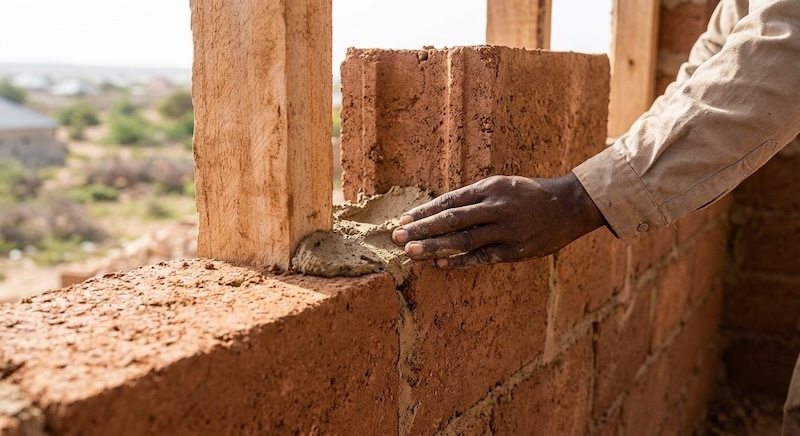
As Somalia’s construction industry expands, growing attention is being paid to the materials used to build the country’s homes, offices, and public buildings. Sustainable and locally sourced materials offer a compelling combination of lower costs, reduced environmental impact, and design solutions that are naturally suited to Somalia’s climate.
Coral stone, quarried along Somalia’s extensive coastline, has been used in Somali architecture for centuries and is experiencing renewed interest today. Its natural thermal mass helps regulate indoor temperatures, keeping interiors cooler during the day and reducing dependence on mechanical cooling, while also connecting new construction to Somalia’s architectural heritage.
Compressed earth blocks and stabilized soil bricks are also gaining attention as alternatives to fully imported cement-based materials. These techniques use locally available soil, often combined with a small percentage of cement or lime for stabilization, to produce building blocks that are both cost-effective and well suited to Somalia’s warm climate.
Timber use in Somalia remains limited given the country’s arid and semi-arid landscape, but where available, locally sourced wood is being used thoughtfully for roofing structures, doors, and interior finishing rather than primary structural elements, helping preserve limited forest resources.
Recycled and reclaimed materials are slowly finding a place in Somali construction as well, particularly in urban redevelopment projects where existing structures are being renovated rather than demolished and rebuilt from scratch, reducing both costs and construction waste.
As Somalia continues to rebuild, the choices made around building materials will shape not only construction costs, but also the long-term sustainability and cultural character of the country’s built environment. A thoughtful blend of traditional knowledge and modern building science offers a promising path forward.